




Seven nations are locked in a high-stakes struggle for dominance as the South China Sea dispute reaches a critical fever pitch. The South China Sea is not merely a body of water; it is a vital artery for the global economy. In 2023 alone, roughly 10 billion barrels of petroleum and 6.7 trillion cubic feet of liquefied natural gas surged through these waves. Beyond the cargo ships, the seabed hides vast oil and gas reserves, while the waters provide some of the world’s most productive fisheries.
Nations do not scramble for these tiny reefs and uninhabited islands for their hospitality. They seize them because these “specks of land” act as anchors for maritime claims. By controlling a reef, a nation can extend its grasp over the surrounding resources, shipping lanes, and energy potential.
A Web of Overlapping Ambitions
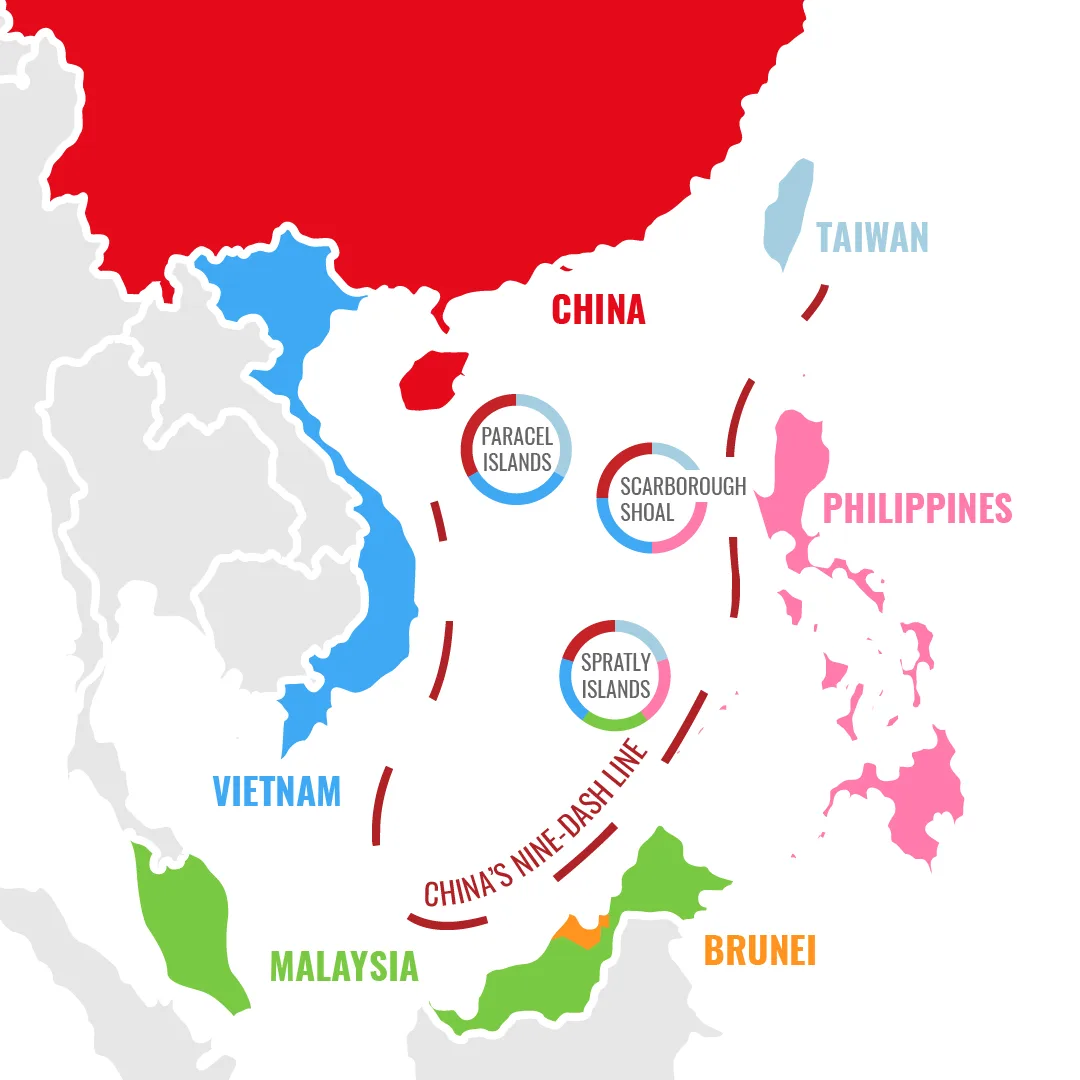
The regional map is a tangled web of “dashed lines” and exclusive zones. Two primary battlegrounds define the conflict: the Paracel Islands and the Spratly Islands.
China’s Bold Reach
As Asia’s largest powerhouse, China asserts dominance over nearly the entire sea through its “ten-dash line.” This sweeping claim frequently ignores international standards, specifically the United Nations Convention on the Law of the Sea (UNCLOS). Beijing’s ambition places it at odds with almost every neighbor, as it builds heavily militarized outposts on artificial islands like Mischief Reef and Subi Reef.
The Philippines: A Frontline Standoff
The Philippines remains one of the most vocal challengers to China’s expansion. For years, Manila has maintained a heroic, weathered garrison aboard the BRP Sierra Madre, a grounded World War II ship on Second Thomas Shoal.
Tensions reached a boiling point in 2026. Philippine officials recently confirmed a dark turn in the conflict: laboratory tests proved that Chinese fishing boats used cyanide near the shoal in late 2025. Manila labels this “environmental sabotage,” while the standoff at sea remains live and dangerous.
Vietnam’s Rapid Expansion
Vietnam borders the eastern edge of the sea and is playing a fast-paced game of “land reclamation.” By mid-2025, Hanoi had created more than 2,300 acres of artificial land in the Spratlys. While their facilities are less militarized than China’s flagship bases, Vietnam is on track to match the sheer scale of China’s reclaimed territory.
The Economic Defenders: Malaysia, Brunei, and Indonesia
For these nations, the dispute often centers on the Exclusive Economic Zone (EEZ).
- Brunei focuses on its 200-nautical-mile zone, which overlaps directly with China’s nine-dash line.
- Indonesia has successfully negotiated boundaries with Vietnam but faces recurring friction with Chinese vessels in the vicinity of the Natuna Islands.
- Malaysia relies on its Continental Shelf Act to claim seabed resources. While Malaysia disputes China’s presence at James Shoal, it has found more success through cooperative energy-sharing deals with Brunei.
The Legal Ghost: The 2016 Ruling
In a landmark 2016 case, an international tribunal ruled largely in favor of the Philippines, declaring that China’s dashed-line claim had no legal basis. The court also stated that building artificial islands does not grant a nation an exclusive economic zone. However, China continues to dismiss the ruling, leaving the legal victory as a “ghost” that haunts the ongoing physical confrontations.
A Future on the Edge
The South China Sea remains a tropical powder keg. Monsoons and typhoons may dictate the weather, but geopolitics dictates the peace. With trillions of dollars in trade at stake and 2026 bringing new allegations of ecological warfare, this strategic frontier remains the most contested water on Earth.


