




Understanding bra sizes is important because someone with a G cup and a 32 band will look very different from someone with the same cup size but a 38 band. Bra sizes are determined by two key measurements—the underband, which is the circumference around your ribcage just below your bust, and the cup size, calculated by the difference between your bust and underbust measurements.
If your size is 36E, 36 refers to your underband measurement—meaning your ribcage measures roughly 34 to 36 inches. The letter E indicates your cup size. This is calculated by subtracting your underbust measurement from your overbust measurement. For instance, if your overbust is 41 inches and your underbust is 36 inches, the difference is 5 inches. Since E is the fifth letter of the alphabet, it corresponds to an E cup.
Mind blown yet? It’s simpler than it sounds! But wait, there’s more…
If the perfect bra style is unavailable in your exact size, you can use a handy trick called sister sizing to get a similar fit.
What is sister sizing?
Sister sizes have the same cup volume but different band sizes. For example: a 32C has the same cup capacity as a 34B; a 32B is the same cup size as a 34A; and a 36C shares the same cup volume as a 34D, and so on.
The rule is simple: to find your sister’s size, go up one band size and down one cup size, or go down one band size and up one cup size.
If your usual size isn’t available, try the sister size for a close fit that feels just right.
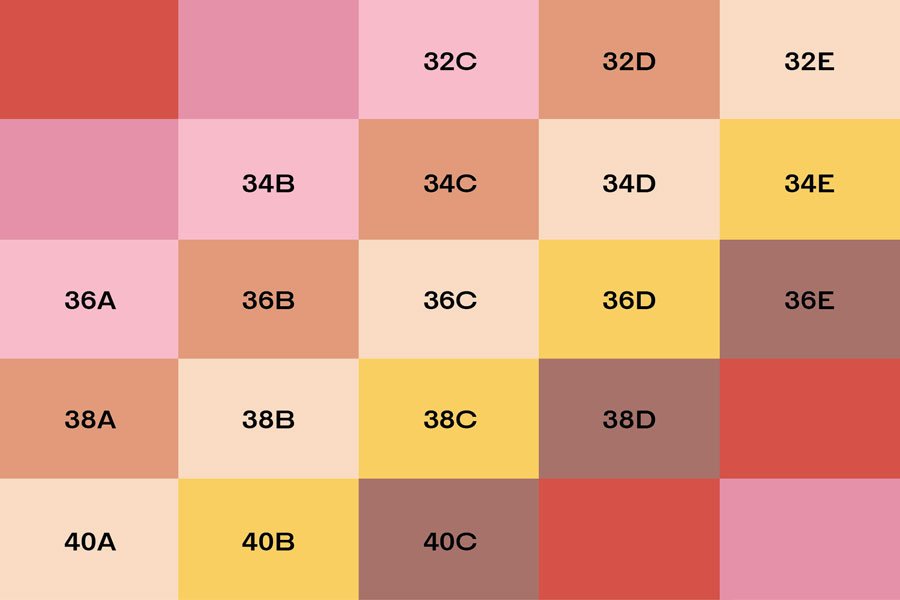
To make it simple—see the chart below (just for fun):

So if you are a C cup, you could be the same size as an A cup; it all depends on your underbust size. Confusing right?!
Bra support explained:
Understanding bra sizes also means recognizing how bras are designed to support different body types. If you have a smaller bust and a more petite frame, you can usually get away with narrower straps, thinner elastics, and a single hook and eye at the back.
If you have a larger bust to support, wider straps, stronger wires, and generally more construction is required to do the work to keep those puppies up. You’re welcome.
It can be a bit disappointing when you see the B cup model online and the bra you’re buying looks completely different in your size. Never fear, though, because it’s all done to support your pups.
How to find your bra size
Please note that this is a general rule of thumb and requires a tape measure, a non-padded, well-fitting bra, and potentially a mirror.
1. Visit the online store for our easy-to-use fit calculator to determine your size.
2. Measure your underbust with the tape measure parallel to the floor. If unsure, use a mirror or a good friend (bad friends won’t work).
3. Enter your findings on our calculator.
4. Then measure your overbust across the fullest part of your bust, parallel to the floor. Hold this firm, but be careful not to pull it too tight so that it hits your bust.
5. Enter your findings into the calculator and voila!
There’s your size.
This is based on a nifty algorithm that calculates your size by calculating the correlation between your underbust and overbust. Clever, yes?
However, please remember that the tape measure is not the best way to work out your size if you have a fuller bust, as, just like the scales, it can also tell lies.
Finding the best fit
Ok, so you’re in the fitting room and you think the bra you’re wearing fits, or is pretty close to fitting. Here’s a list of some things to check along the way:
1. Underband first—let’s go! It’s best to fit on the middle hook, by the way.
- Is the bra riding up your back? If yes, go down a band size.
- Does the bra feel too tight around the body? If yes, go up a band size. A little hint here is whether you can breathe.
2. Now the cups. The wires need to be nowhere near your breast tissue at all.
- Are the wires on your breast? If yes, go up a size.
- Is the top cup digging in? If yes, go up a size.
- Is the top cup wrinkling? If yes, you may need to adjust your straps.
- Do you feel supported by your bust (aka nipples facing forward)? If not, you may need to change the bra style to something more structured and supportive or adjust your straps.
If you follow these simple steps each time you try on a bra, you’ll be sure to find the perfect fit each time.
Not all styles of bra suit every bust and body *shock horror*. Just like no one style of jeans will be great for everybody.
Work out what works for you and what type of clothing you like, and the rest will fall into place (slight pun there).
- If you like to wear white t-shirts, then a nude t-shirt bra would be great.
- If you like plunging, scoop-neck tops, a plunge bra with a low front could work.
- If you have sloping shoulders, try a more triangular bra.
- If you are wider set, try a balconette bra.
Final take
Whatever your bra size, breast shape, or body type, remember that you are unique and there will be something out there for everyone.
Understanding bra sizes means knowing that different brands have their sizing methods, and sizes can vary between styles and seasons within the same brand. Additionally, your size may change daily or depending on your style. Being aware of these factors is essential for finding the perfect fit.
For the best outcome, always try it first. If in doubt, buy a seamless bra that covers a range of sizes


